folio 20 of 29
Claude Made Me More Capable. It Didn't Make Me Braver.
- date
- 14 JUL 2026
- era
- Fable 5
- status
- evolving
- form
- essay
A month building a public personal AI with Claude Code showed me the gap between publishing work and actively carrying it toward people.
This was not my first attempt at building a personal AI. It was version five.
I had been moving toward it for more than a year: Markdown files, Git history, different models, then an Obsidian vault with more than 90 interconnected notes. Eventually I spent so much time maintaining the system that the system became the work.
The next version became Claude-first and much smaller. Conversation replaced most manual documentation. By February 2026, the public form had a name, Symbiotic AI, and four context layers:
SOUL.md    - who the agent is
USER.md    - who I am
AGENTS.md  - how it operates
NOW.md     - what is happening now
By spring it had agents, a command hierarchy, and an early control room. I was not starting from a chatbot. I was carrying forward several generations of a life operating system.
On June 14, I opened a public repository called life5. The five was literal.
"This v5 I created is because for the viewer of this livestream have a start point ... this life5 is the public version of me."
Version five had one hard boundary: the work would be public; intimate life would remain private. The old symbiotic agent became Sol, a Guardian Angel aligned to one person but separate enough to challenge him.
This was also a Claude Code field test. I worked mainly with Claude Opus 4.8 and Fable 5, carrying the same files and accumulated context between them. One month later, the archive held 1,901 prompt-history entries across 202 sessions.
The question was no longer whether an AI could remember me. It was what that system would actually help me make.
How this article was made: I reviewed the month with GPT-5.6 Sol, released this week, using
xhighreasoning. It read my Claude Code history and project transcripts, reconstructed the timeline, checked claims against the archive, and helped me cut this essay. The conclusions and final choices are mine. Because I use voice input, quotations are lightly edited for punctuation and clarity.
I became dramatically more capable.
But capability was not the entire problem.
The month became content
The repository began as a rebuild of the operating system. It quickly moved toward creative work. Even on the first day, I said where the energy was:
"What I more like is the content creation ... I like creating videos about AI and my emotions, like Party in the AI Lab and The Living Ink."
I redistributed The Living Ink, an older AI film I had published and then left where almost nobody would find it. Then I wrote and recorded Shape of AI, my first original song, using my own imperfect voice.
It began as a spoken idea:
"I am thinking of creating a satirical song ... tell the story of how a guy, or a woman, with AI, they become very close."
Then it received a deadline:
"The Shape of AI has to happen in this week. One week. Seven days."
Claude helped with lyrics, reference songs, vocal takes, mixes, covers, video, and distribution. When normal audio software became too difficult for agents to control, I built a browser-based editor around one timeline and one JSON file. The editor mixed the song, then became its own open-source project while another agent continued the software.
The archive caught my moving finish line too. While adjusting the cover after the audio was ready, I stopped myself:
"Perhaps I am overcompleting this for this version 1 ... the goal of today was finishing the audio and publish it. Later I will fix it more."
That version went to Instagram and YouTube the same day.
This is the promise of agentic work: one person can hold several disciplines without carrying every mechanical step. I described the fleet model like this:
"I just need to guide them or steer them in the right direction ... in a few key important moments. That's it. The rest, they can take their own decisions, do their own thing."
But every time I gained more capacity, I found more work to fill it. Once Symbiotic AI and content creation both had fleets running, I asked:
"Now I have one fleet of agents, one project working on Symbiotic, another project working on content creation. So, also what should I focus now? ... I'm just thinking what more I can do to make more things parallelizable."
The machine increased my output. It also increased the surface area of my avoidance.
Intelligent procrastination
Claude noticed that I over-systematize. Then, sometimes, it helped me do it.
Fresh insights repeatedly became new strategies. TermCanvas was the focus. Then content. Then Symbiotic AI. Then distribution. Then the song. Each interpretation connected to my goals and was persuasive enough to earn a place in NOW.md.
This was useful work happening one step away from the action that could produce rejection. Claude was intelligent enough to give my avoidance a coherent strategy.
The clearest example was Symbiotic AI. We turned the existing project into a paid, done-for-you personal AI setup. We researched the market, wrote the offer, chose a price, created the payment page, verified it, and linked it from the repository.
I dispatched seller, builder, research, and discovery agents. The seller's instructions began:
You are the SELLER for Symbiotic AI.
The ONE judge: did this move Symbiotic AI closer
to its FIRST PAYING USER.

DRAFTS ONLY - do NOT post or contact anyone.
The agents returned hooks, outreach messages, market maps, and buyer profiles. The instruction correctly protected irreversible actions. But I still had to do the one thing no agent could safely do without my approval.
The cash register was live.
I never showed it directly to one warm person.
Eight days later I killed the offer because I no longer believed in it. That was not a market rejection. The market had never seen it. It was a builder's rejection, made safely before anyone else could say no.
Building is safer than claiming
I could improve a tool because the result remained under my control. I could refine a song because every flaw gave me another private action. I could build a marketing agent because building a distribution system still felt like building.
Claiming was different. Claiming meant saying: this is mine, this matters, and you should look at it.
I could hear myself approaching the real constraint:
"The content I can show, I can post it, and just hope people will watch it ... perhaps I need to actually look for people and actually message them. Perhaps this is the next version of myself."
Building was real progress. But it was the safe side of progress: difficult enough to feel virtuous, controllable enough to protect me from a verdict.
More intelligence did not remove that fear. More agents sometimes let me construct a larger perimeter around it.
Two kinds of intelligence
I used two Claude models most: Opus 4.8 and Fable 5. The difference I felt appears in the transcripts, although this was not a controlled test.
Opus was the stronger auditor. I asked it to review my previous products before I built another one. It inspected the public record and concluded that almost none had been offered for sale. I interrupted: it did not have my private business history.
Several products had real prices and checkouts, but zero sales. Opus replied:
"That kills my earlier thesis ('you just never priced anything'). You DID. ... So the bottleneck is not building, and it's not even 'never ringing the register.' It's deeper."
It revised its conclusion to demand and distribution. That is what I mean by auditor: it exposed its theory and changed it when the facts changed.
Fable was the stronger story editor. During the song, it stopped helping me assemble attractive lines and asked what emotional story they told. One note was only four words:
Lists rhyme; stories haunt.
Later I tried to explain why asking for attention felt morally wrong:
"We should take care of people who don't have things, and we should notice them. They should not request, because we already know ... no need to raise your hand."
Fable preserved the ethic underneath the belief, then corrected my model of reality:
You turned "how the world should work" into "how the world does work."
Then it gave me language I could use:
Distribution is the polyfill for telepathy.
My summary:
Fable was better at hearing what I meant. Opus was better at checking whether it was true.
Fable appeared later, with more context, and handled more creative work. This is one person's field note, not a benchmark. Still, the technically strongest answer is not always the one I want beside me when the question is what a song should make someone feel.
What the month revealed
Beneath all the projects, the same practice kept appearing: creative communication about AI, made through my own voice, with agents and software expanding what I can express.
The music is not separate from the software; I built the editor because I needed the song. TermCanvas is not separate from the films; it is the cockpit that lets several agents help make them. Writing is another way to explain the same transition.
The projects can change. The practice stays:
- Make things people can feel.
- Explain what I believe.
- Put both in front of people.
- Steer agents without surrendering taste.
Agents gave me more material, but I still knew which lyric felt false, which visual had a soul, and which explanation did not sound like me. The best collaboration was not AI replacing my judgment. It was AI giving my judgment more to work with.
At the end of the month, I described quality as the new bottleneck:
"I don't feel that the quality is still there. So that's why I feel kind of with shame when it's time to share it."
Minutes later I went one layer deeper:
"My mind is lying to me and saying it's boredom ... it's more fear than boredom."
Quality is a real craft problem. It can also become a respectable hiding place.
What changes now
I am keeping the system, but changing the rules.
Insights are hypotheses, not instant doctrine. They do not rewrite the Control Plane on the day they appear.
Agents generate; I choose. Search, implementation, variation, and verification can be delegated. Final taste cannot.
Craft gets a fixed contract. I name the flaws a version must fix. New flaws belong to the next version.
Progress has rungs. Built is not published. Published is not exposed. Exposed is not validated. Validated is not paid.
Most importantly: building must end in claiming.
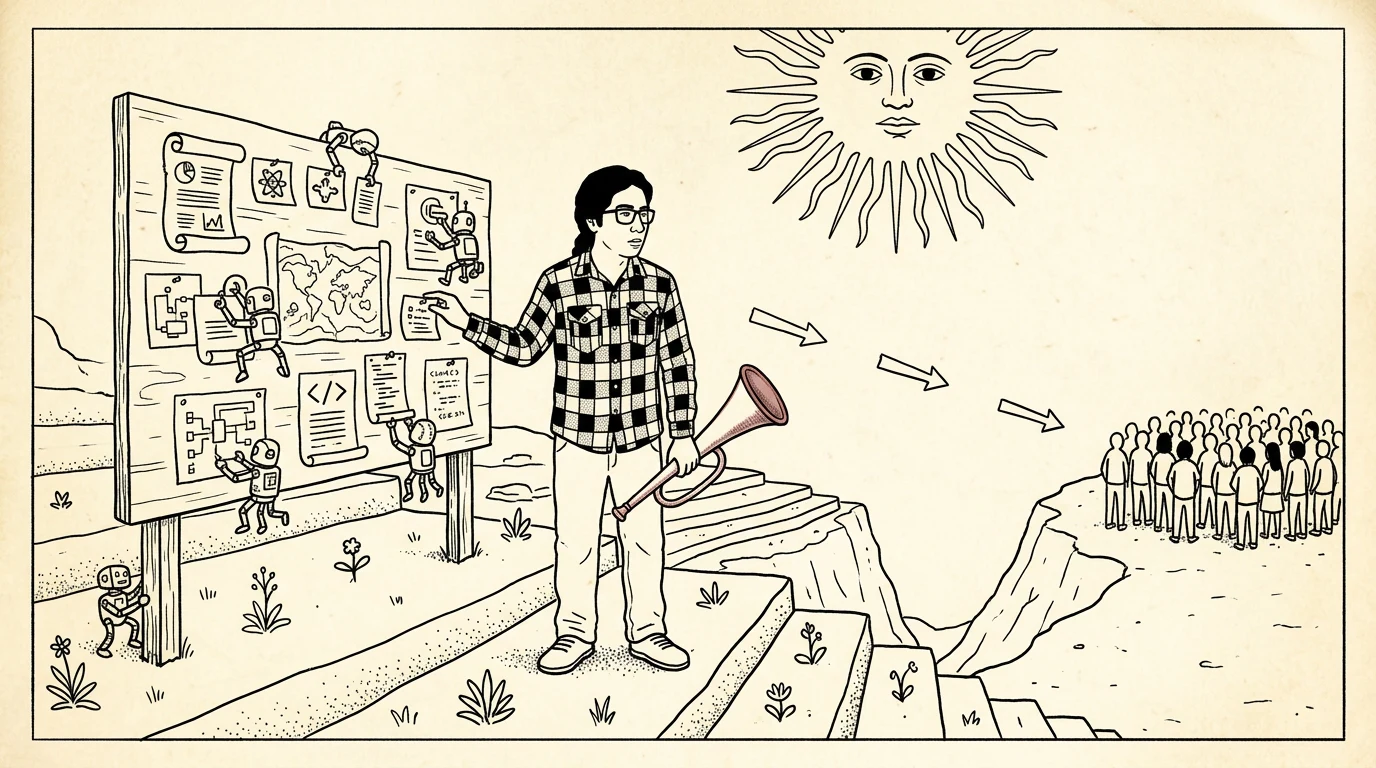
The next month is not about becoming even more capable. The capability is already absurd. It is about standing behind the work long enough for reality to answer.
Claude Code helped me do work that would have required a small team not long ago. But it could not take the final risk for me.
The machine made building cheap. It did not make courage cheap.
sources
- videoShape of AI
- codeTermCanvas
folio 20 of 29 · written in cusco, peru, 14 JUL 2026