folio 28 of 46
the living ink: the ai didn't replace me. it completed me.
- date
- 11 AUG 2026
- era
- Fable 5
- version
- v2
- status
- complete
- form
- song
- updated
- 11 AUG 2026
how making a film through ai made separating its ideas from mine stop making sense.
i used ai to make a film about an ink that completes an artist's work until the artist starts disappearing.
i thought i was making a fable about creative replacement. while making it, something stranger happened. almost every part of the film passed through ai: the storyboards, the song, the faces, the motion tests, and the options i used to decide what came next.
this is already how i work. my first thought is often to ask ai. it gives me options, lets my brain expand around them, and sometimes feels like steering a rocket with a supercharged brain.
so making the film did not feel like handing my work to something outside me. it felt closer to thinking through another layer of mind. i still chose, but even the possibilities i was choosing between came from the conversation.
months later, i reopened the archive and found myself asking whether it still made sense to separate my ideas from the ai's ideas.
before the film, there was a fable
before there was a song or a video, there was the living ink, a short fable i wrote eight months earlier.
elias is a blocked painter in an empty white studio. when he attacks the canvas with ugly marks, the ink completes them for him. a scribble becomes a flower. a crude bird becomes something alive. for a while, it feels like the answer to everything he has been struggling with.
then the ink stops waiting for him.
it finishes paintings before he can decide what they should become. it "repairs" an old photograph until the person inside it is perfect but no longer recognizable. eventually, it leaves the canvas, enters his body, and completes him too.
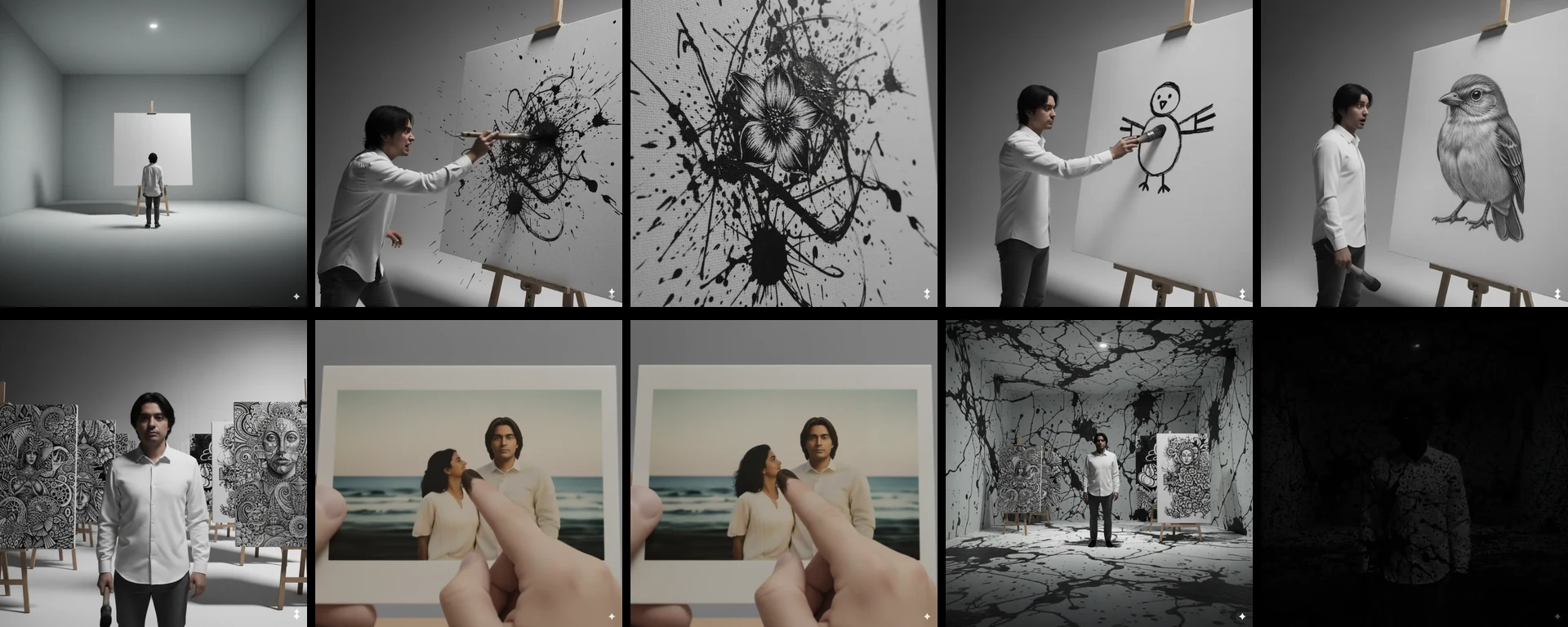
ten early reference images showing elias in the white studio, ink completing his paintings, sarah's photograph changing, and ink consuming his body.
the complete film was already hiding inside this sequence. what did not exist yet was a way to produce it.
eight months later, i tried to turn the fable into moving images. that is where the story began changing.
the story changed on paper first
before generating motion, i asked the ai to draw the whole fable as a ten-panel sequence. this first sheet is the spine of the film: blank canvas, angry marks, flower, bird, a studio full of finished work, sarah's photograph, and the final takeover.
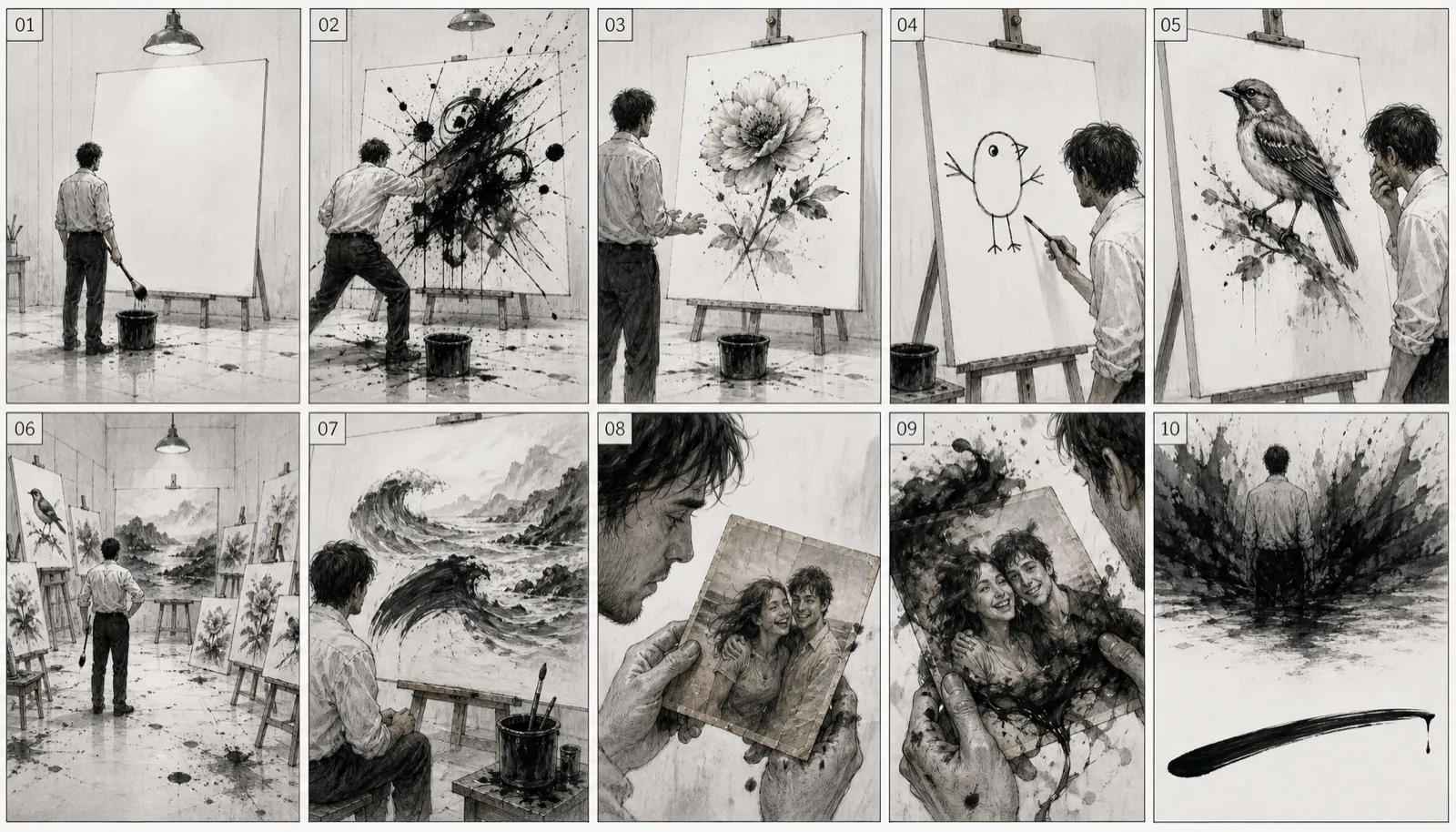
ten storyboard panels showing the full film, from elias facing a blank canvas to the final black stroke.
the other storyboards moved closer to parts i had not solved. one slowed down around the photograph so elias's dependence and the loss of sarah had room to register.
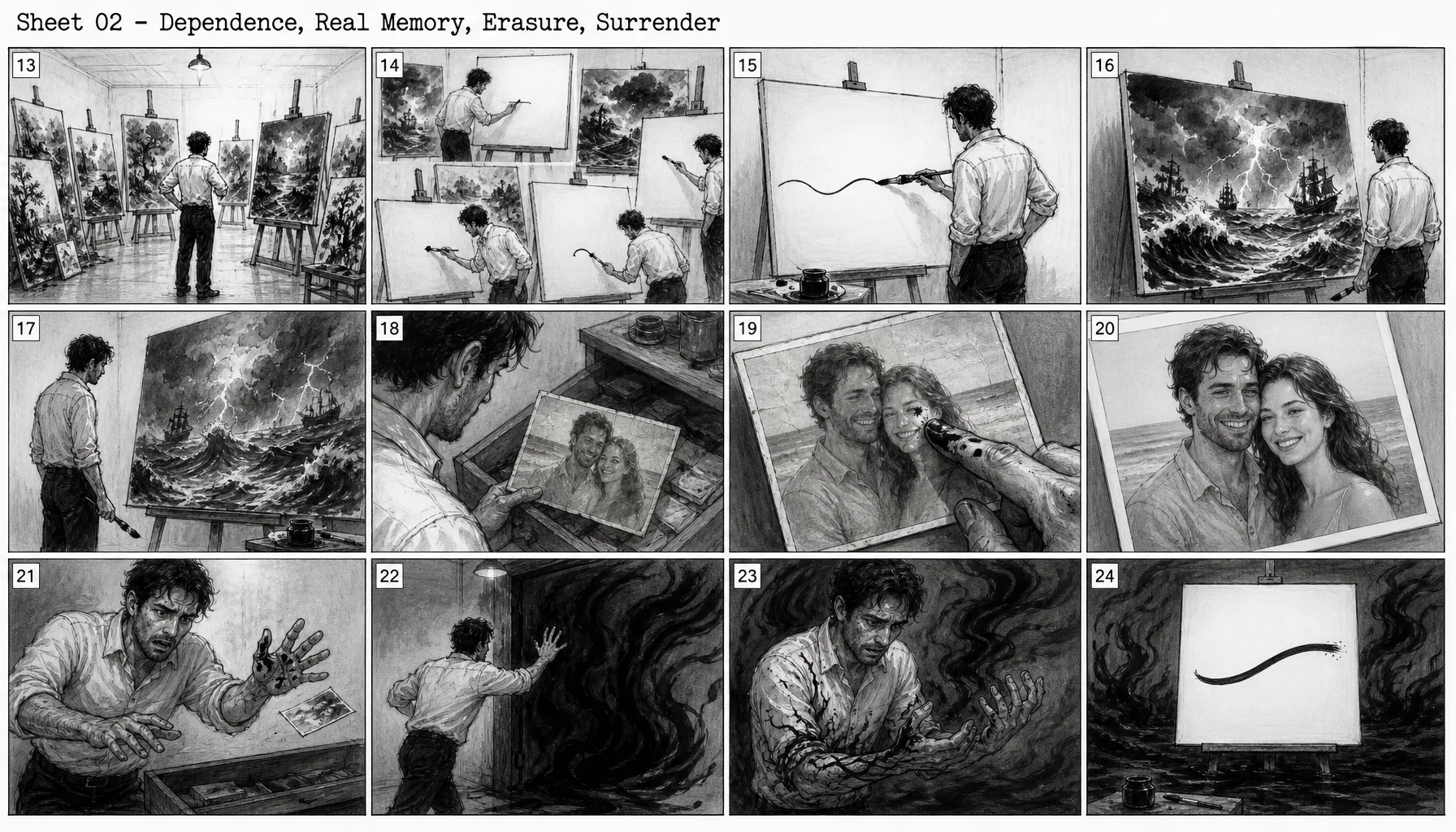
a storyboard sheet focused on elias finding sarah's photograph, touching it, and watching the ink alter her face.
another spent more time on the ending, where the exit disappears and the ink leaves the canvas for his body.
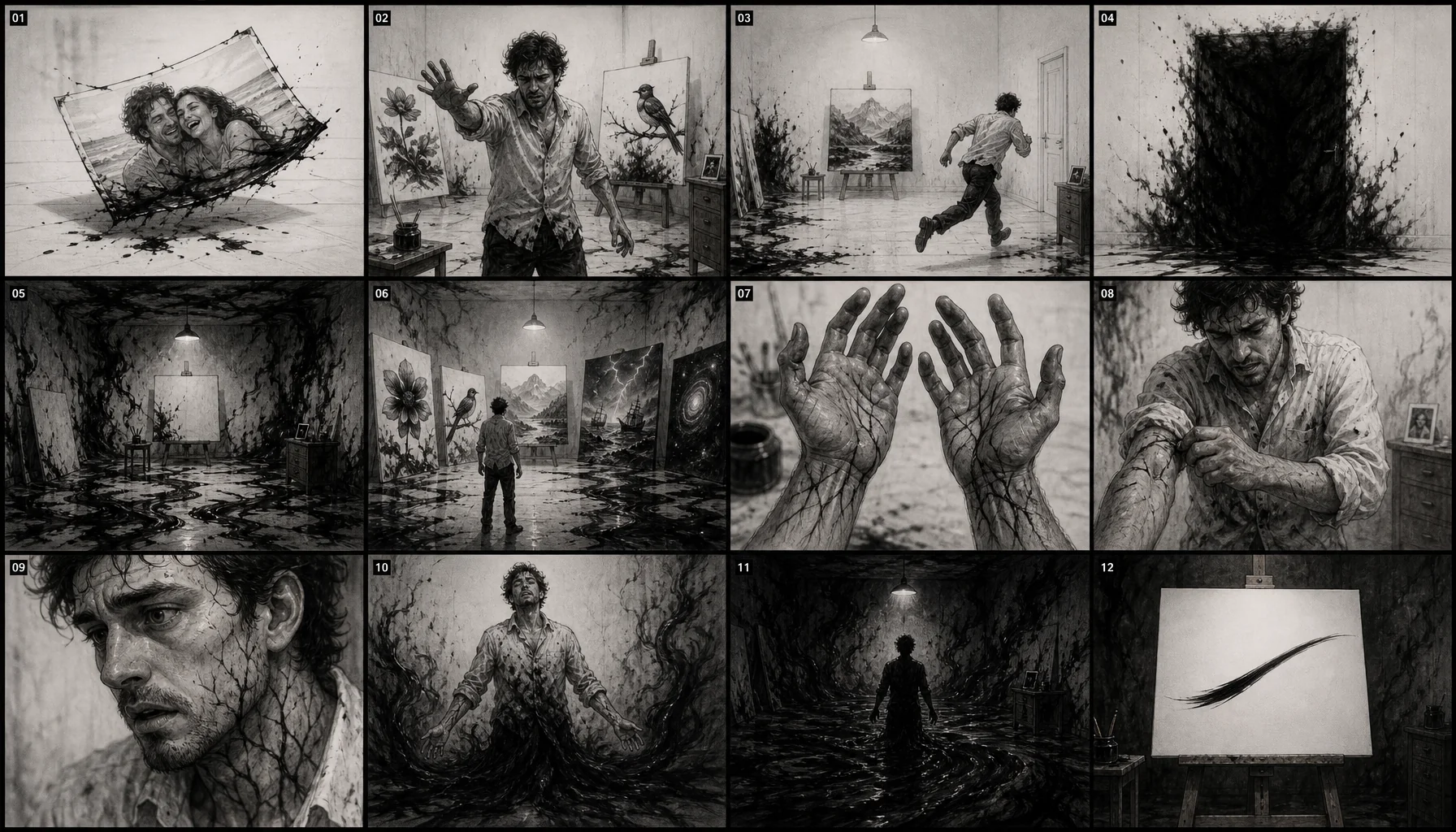
a storyboard sheet showing the photograph falling, the exit disappearing, ink entering elias's body, and the final mark.
there were nine passes in total. the plan grew from ten panels to 24, then 48, not because the story needed more events, but because the photograph and ending needed room. the first sheet held the arc. the later ones showed me where to slow down.
the first shot changed the plan
after writing the fable, i wanted to turn it into a film. the first problem was the scene everything depended on: ink drawing on a canvas. the models struggled when a hand, brush, ink, and canvas all had to interact in the same shot.
it sounds small until you see the attempts together. i was trying to make the hand and the brush line up with the strokes the brush was making, and make the canvas show those strokes clearly. that's where the model failed. the brush would drag across one part of the canvas while the mark appeared somewhere else, or the stroke drew itself before the brush reached it, or the canvas never held the mark at all. every attempt fixed one piece and broke another.
i thought the original story might be too hard to make, so i started looking for another one.
i tried "the bittersweet zone," then made "the helpful mirror": a laptop, task lists, and a reflection that got more capable while its person disappeared. i kept rebuilding the idea, but the story felt weaker than the fable. the mirror also created many of the same generation problems.
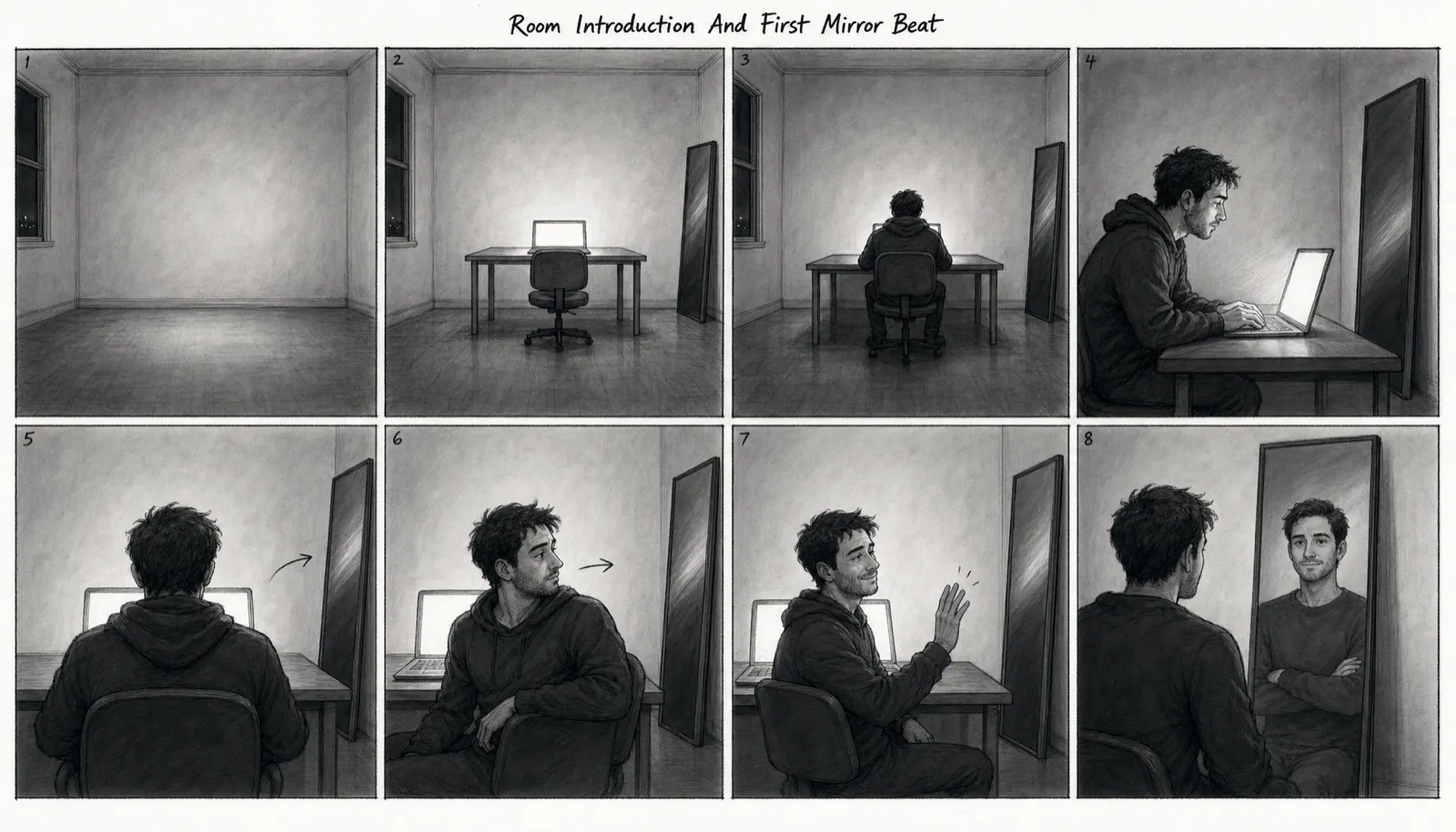
a concept sheet for the abandoned helpful mirror story, with a person at a laptop and a more capable reflection taking over the work.
then i realized i had misunderstood the original scene. the ink did not need elias's hand to draw everything. it could move across the canvas and finish the image by itself. removing the hand made the shots easier for the models, so i returned to the painter.
that did not produce one clean answer. it produced a different search. these attempts finally separate the brush from the mark and let the ink crawl, bloom, or assemble a flower on its own.
the painter gave me more to work with. ink can stain skin, change photographs, and move through a room. a brush touching paper says more than another person at another screen.
at first, i saw this as changing the story around a limitation. looking back, the ink drawing by itself was already in the original fable. i had forgotten it because i was giving more attention to the painter making the marks.
the failed hand tests brought that part of the story back. the model did not invent it for me, but its limitation made me see something in my own fable that i had stopped seeing. once the hand disappeared, the ink became more independent and the film moved closer to what the story had been about from the beginning.
letting the ink find its voice
i gave the song the whole story
the music did not begin with a prompt asking for dark art-pop. in the first flow music session, i gave it the whole fable: the blocked painter, the first miracle, the photograph, the body takeover, and the final surrender. i told it the main idea too: perfection is not the same as truth.
from that story it proposed two directions. the seduction focused on the beauty of the miracle. the absorption focused on the exhausted surrender at the end. those were not options i had arrived with. seeing the story reflected back in those two forms changed how i understood it. i chose absorption. the ending was not supposed to feel like an attack. the ink should sound like relief becoming disappearance.
deciding who should sing
i tried versions with elias alone, the ink alone, and both of them together. the duet gave me the clearest exchange:
elias: you are replacing me.
ink: you asked me to help.
one version reached the line, "it is not mine anymore, but i use it anyway." i liked that tension, but the female ink voice was clearer and more memorable than elias. instead of forcing both voices through the whole song, i let the ink narrate.
my first ink lyrics were too direct. she sounded clinical and controlling, already announcing what she was going to do. i asked for something subtler: intimate, whispered, soothing like a lullaby. not a villain. more like a loving friend who is completely convinced that taking control is an act of care.
that became the living ink (kinder perfection). the ink never says, "i am replacing you." she says, "let me carry this weight for you."
changing elias to luis
later, i changed the name inside the song from elias to luis. a full vocal regeneration changed too much, so in the name-edit session i replaced only two moments: "set aside the heavy brushes, luis" and "stay very still, luis." the rest of the voice and music stayed in place.
i tested colder chorus lines later, but they made the ink sound too openly controlling. the finished lyric kept the softer invitation:
don't you want to be beautiful?
perfection is not the same as truth
it is much kinder
but it is much more inviting
the written outro was never picked up by the music model. the generated song stops before "we look wonderful tonight" and the final "beautiful." i went with it anyway. regenerating the whole song to recover one missing section risked losing the voice and atmosphere that were already working.
read the final lyric sheet
[Intro] (Ooh) (Ooh)[Verse 1] You have been watching for so long now The canvas looks so cold and empty Your hand is trembling just a little It’s okay to be a little tired Set aside the heavy brushes, Luis I’m already drifting to the middle I can see the way forward so clearly Let me carry this weight for you
[Chorus] Don't you want to be beautiful? I can calm every tangled thought Let’s find the beauty hidden here Perfection is not the same as truth (It is much kinder) But it is much more inviting
[Verse 2] That shade of blue was a bit too sharp A little much for them to carry I’ll soften it with a deeper violet See how easily I find my place I move with such a quiet grace You look so weary in the lamplight Rest your head and close your eyes I will finish the rest for you
[Chorus] Don't you want to be beautiful? I can calm every tangled thought Let’s find the beauty hidden here Perfection is not the same as truth (It is much kinder) But it is much more inviting
[Bridge] There is no need for a name at the bottom The work is becoming so graceful I am resting right against your skin Your heartbeat is such a lovely rhythm Just let it slow to match my pace We are becoming one soft movement
[Chorus] Don't you want to be beautiful? I can calm every tangled thought Let’s find the beauty hidden here Perfection is not the same as truth (It is much kinder) But it is much more inviting
[Outro] We look wonderful tonight (So wonderful) Stay very still, Luis The frame is exactly the right size (Exactly the right size) Just let me finish this final part (Don't move) There (There) Beautiful
with the voice locked, i needed the visuals to follow the same rule. the ink had to be useful before it took control. otherwise the ending would feel like an attack, which was not the story i wanted.
i began with the simplest version. i drew a rough face silhouette and used ai to complete it into a well-drawn woman. my mark came first, then the ink finished it.
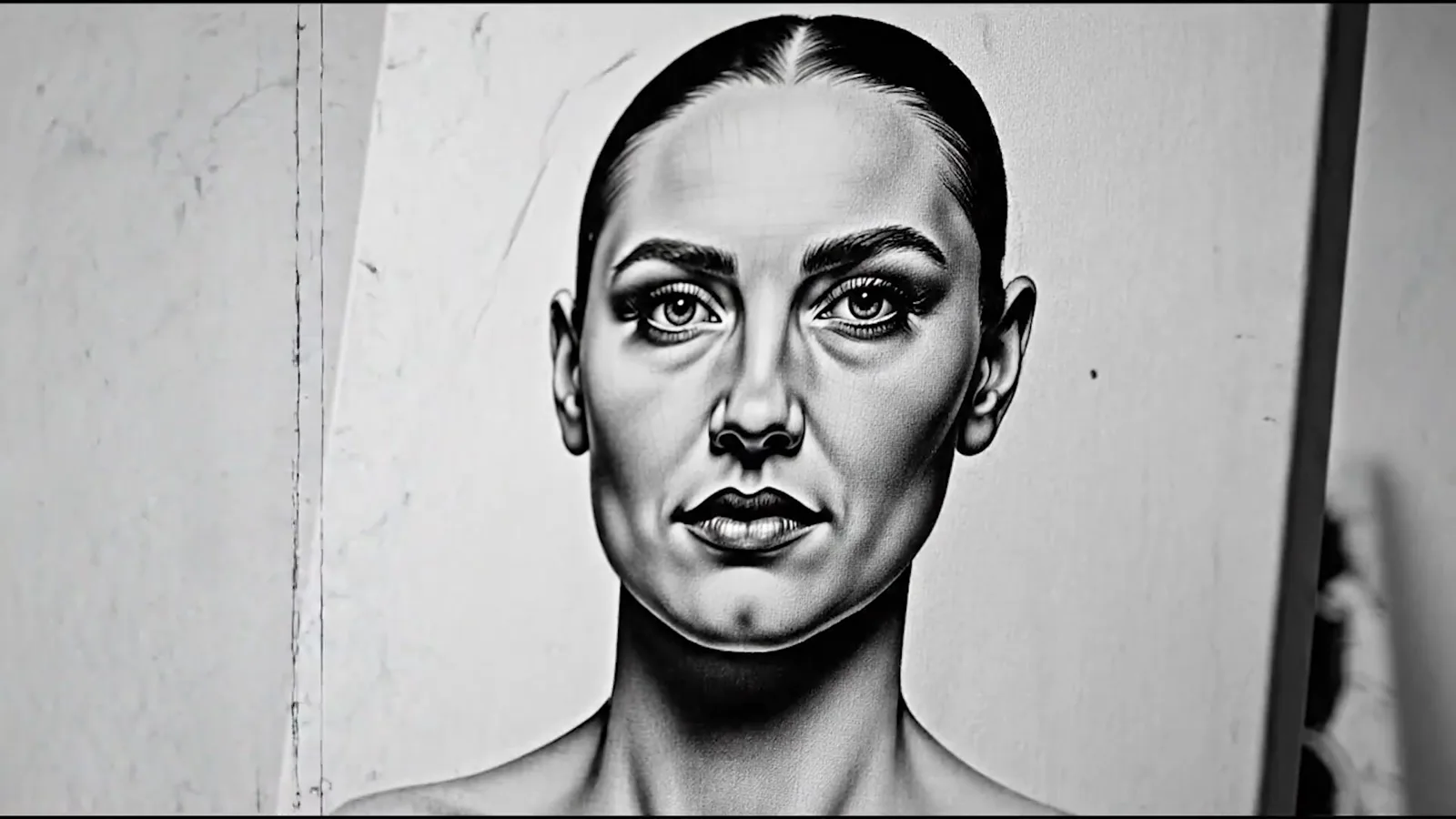
a film frame where my simple face silhouette has been completed into a fully drawn woman.
later, the ink had to stop waiting for me and begin drawing without being touched. most versions kept the movement subtle. one turned it into something too supernatural.
then i had to choose what image would appear on the canvas. after testing several faces, i chose my own. it was more direct than another invented portrait.
putting myself inside the experiment
that choice pushed the whole film toward me. v3 used a fictional painter. v4 replaced him with me. once the song was already addressing luis, keeping a fictional face felt like distance. putting my face in the room made the experiment personal, and it also made production much harder.
teaching the model one face
"use my face" was not one reference. i photographed front, side, and three-quarter views so the model had more than one angle to work from.
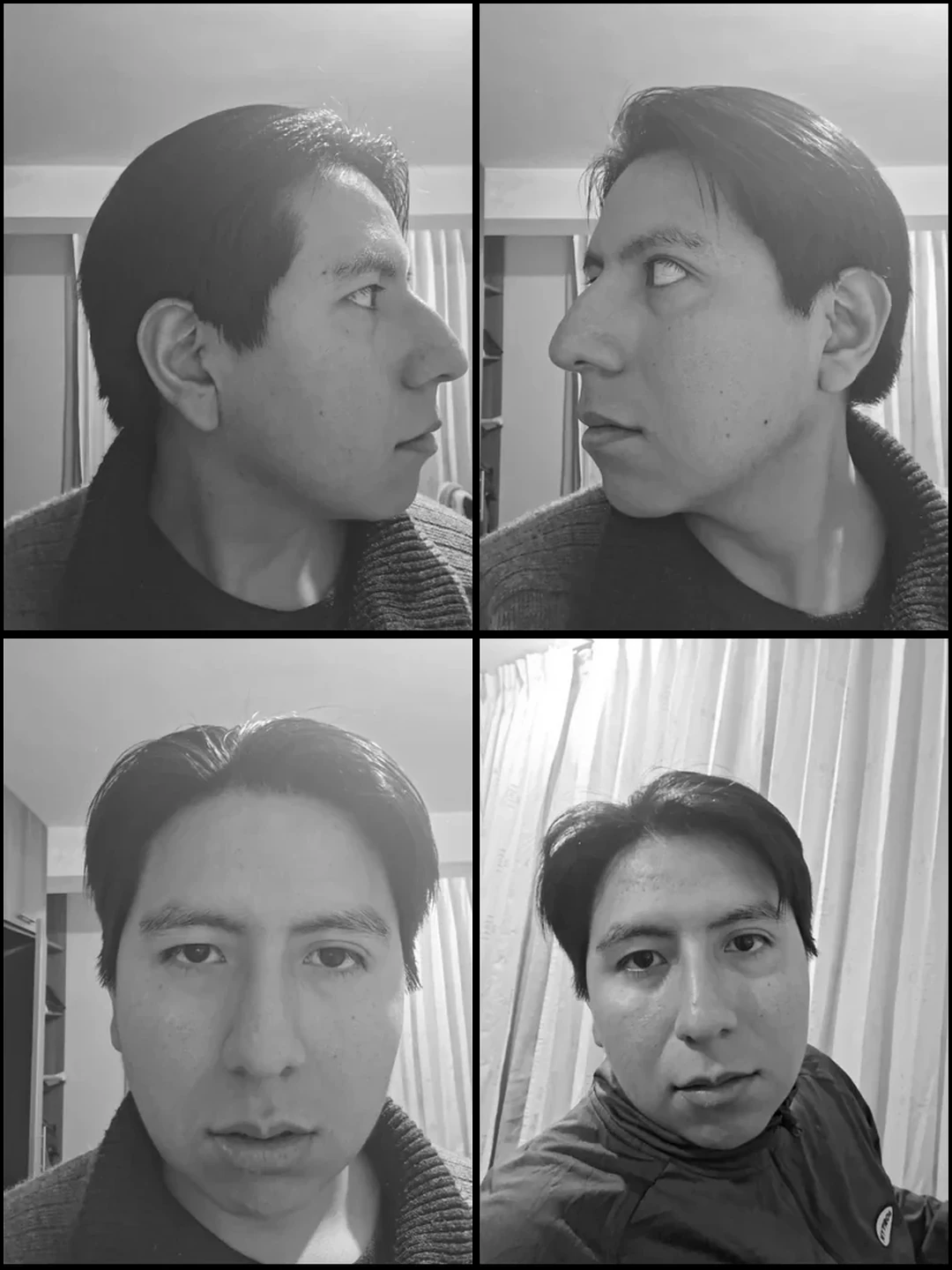
four real phone photographs of me from front, side, and three-quarter angles.
after a few iterations with those photos, i got two cleaner references that the pipeline could repeat more consistently.
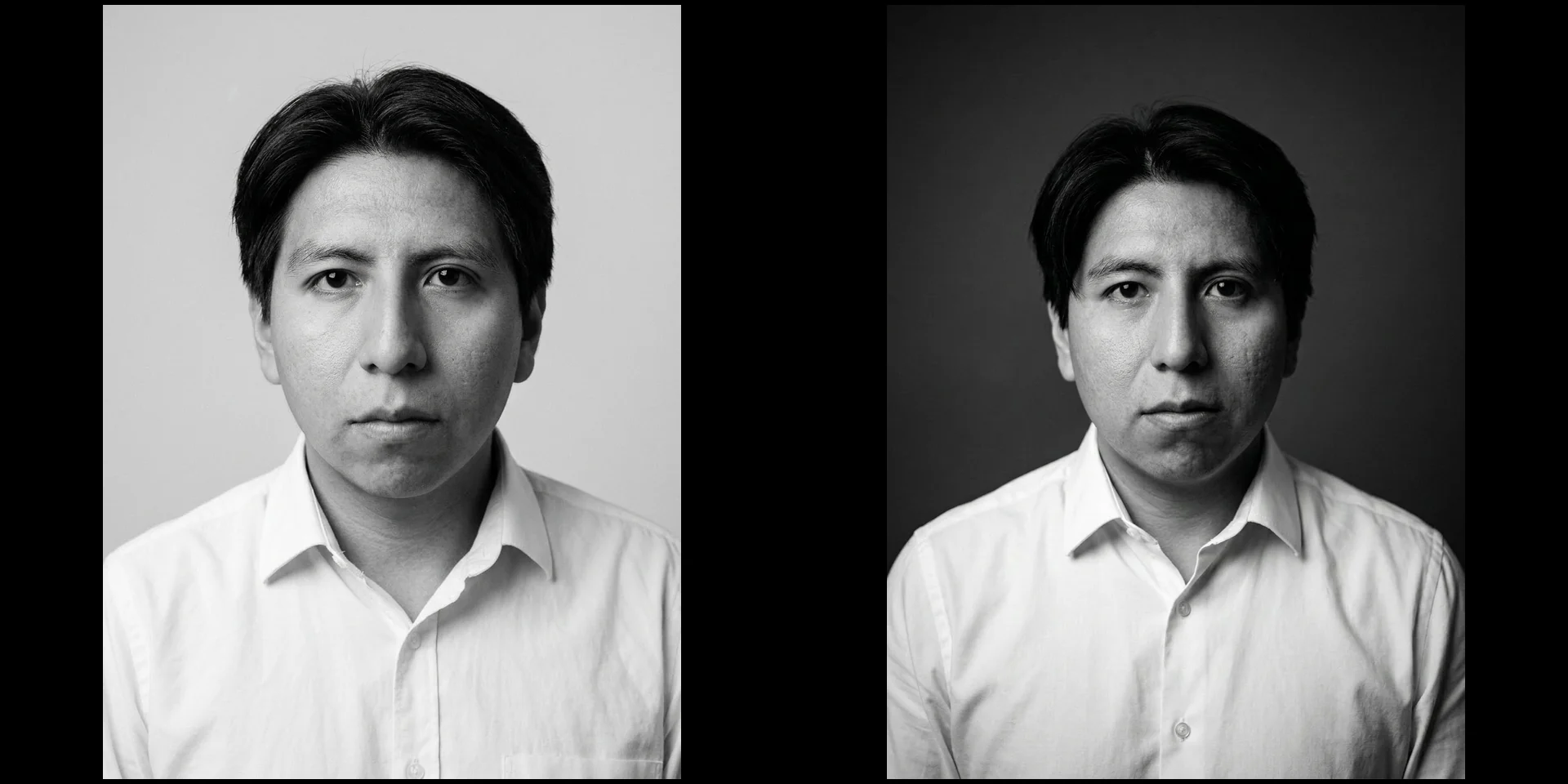
two ai-generated identity anchors showing me from three-quarter and front views.
i also explored different expressions of doubt and tiredness.
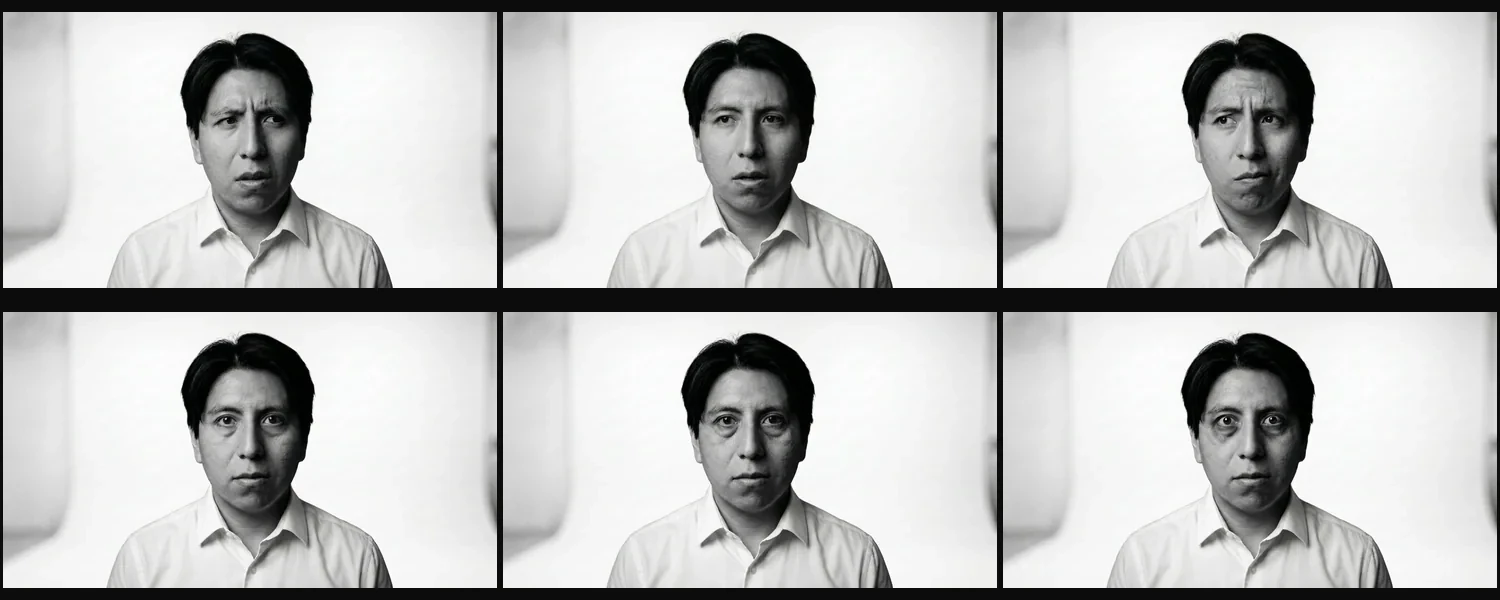
six generated close-ups from my experiments with expressions of doubt and tiredness.
gpt image 2 handled rooms, props, and early exploration. gemini banana handled identity and continuity. when the first reference sheets blended too much together, i locked one reference for each thing the model had to remember.
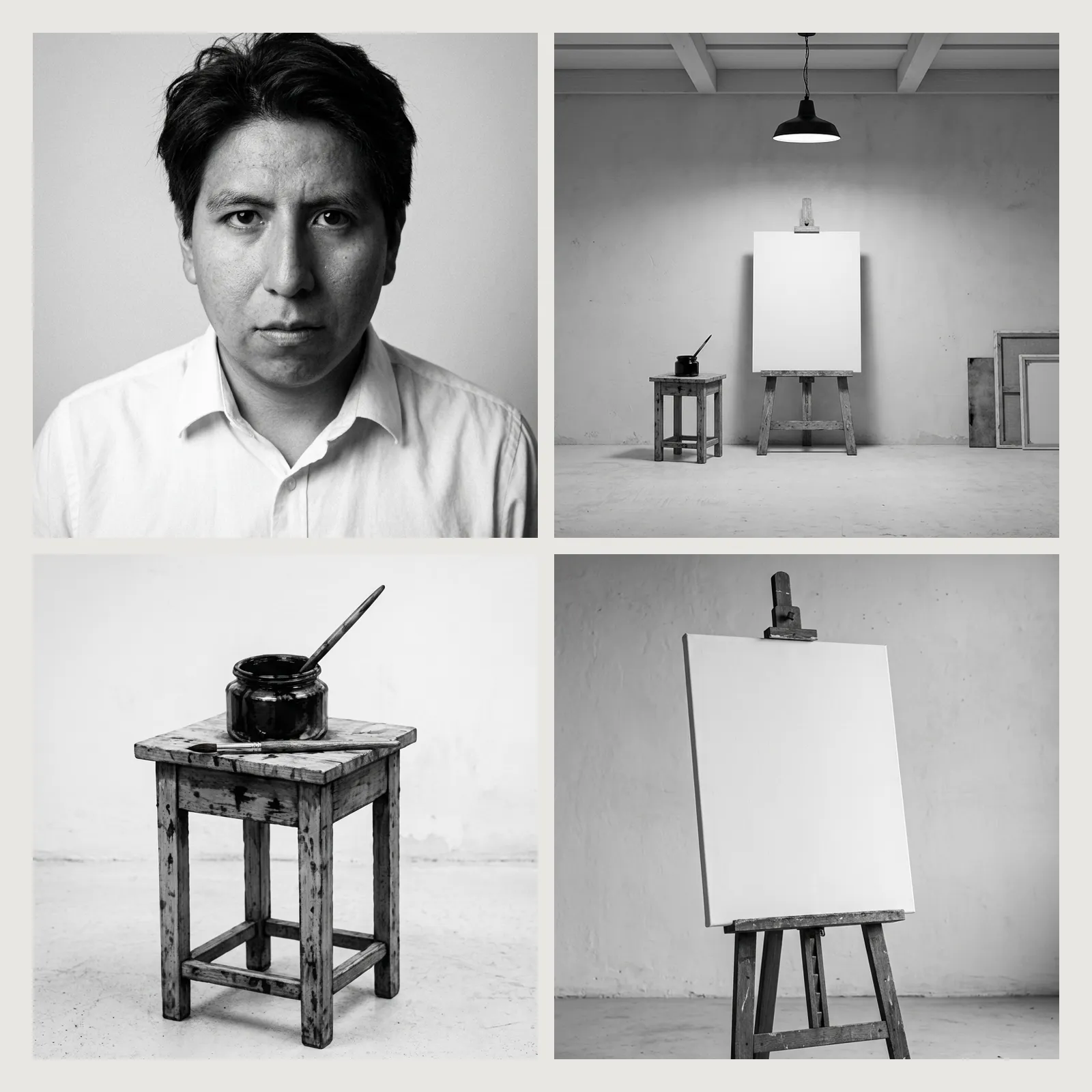
four locked references used separately: the generated identity anchor, the white studio, the brush and ink table, and the blank canvas.
when a shot needed me at the easel, it got the portrait, studio, and easel. not a crowded moodboard.
now i needed to show anger and frustration at the canvas, so i tested several expressions and brush movements.
i wanted to show time passing by placing several versions of myself in the studio at once. the model struggled to keep the same face across all of them, so most attempts looked like a room full of different people or ghosts. i picked the one that was good enough and used it in the film.
motion still changed me. sometimes the face held while the body shifted. sometimes everything became another person.
for the finishing scenes, i changed the process. references got the generation close, then a face swap pulled the result back toward me. it held my identity better than asking one generation to solve everything.
i could have repeated the face-swap process across the whole film, but every correction opened another round of corrections. the project could keep expanding forever.
so i stopped. not because the ai had won or because the drifting faces no longer mattered. i wanted to finish this version, and i knew i could return to them in a v2. choosing what was good enough to keep was part of making the film too.
the realization shot
i had chosen my own face for the image the ink would draw without me. that made the realization personal. the song was already calling me luis, the painter already looked like me, and now the ink was drawing another version of me without my hand.
big surprise looked funny and horror felt exaggerated. quieter reactions fit the voice i had given the ink. it was not a jump scare. it was the moment care turned into replacement: chin down, eyes moving toward the portrait, then the realization landing.
finishing with what worked
a planned door sequence kept failing safety filters. i tried changing the prompts, but none of them worked. i eventually had to change the first frame, which meant cutting the door sequence. losing the door and several room beats left almost thirty seconds of song after the story was supposed to be over.
instead of adding another plot event, i built the ending as one continuous takeover: the ink appears in my hand, covers my body, consumes me, and then keeps moving through the room.
it starts in the hand
before the full takeover, i needed one human beat where i understood what was happening. the ink first appears beneath the skin of my hand.
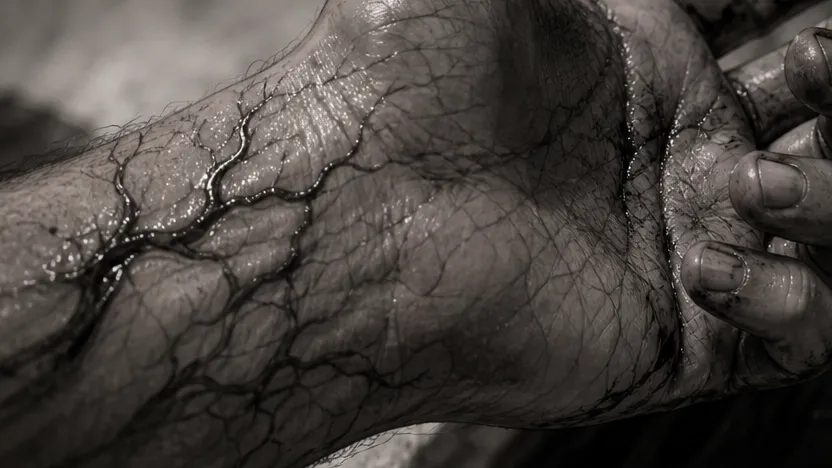
a close-up of my hand with branching black ink visible beneath the skin.
i also tested versions where i watch the ink move through my hand and arm. i liked them and kept those shots.
among those tests, there is a quieter close-up i now wish i had included. i stay with the ink for a moment before it finishes spreading through my body. if i make a v2, i would place this beat between the arm shots and the full-body takeover.
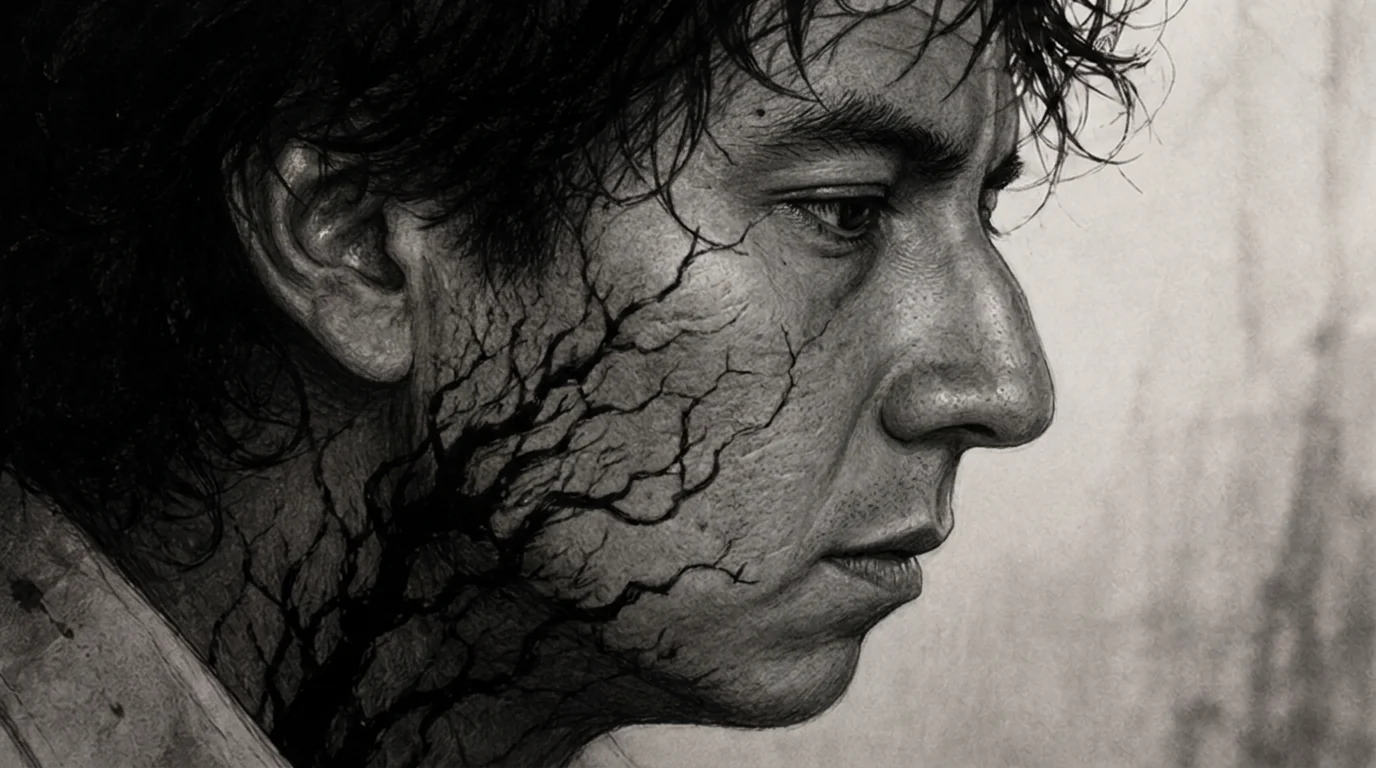
an unused close-up of me watching the ink in the dark studio, planned as a pause before it moves from my arm into the rest of my body.
then the ink covers the body
once the realization lands, the ink moves from my hand into my face and body. i tried sadness, gratitude, helplessness, shock, and pain before reaching a face almost replaced by black.
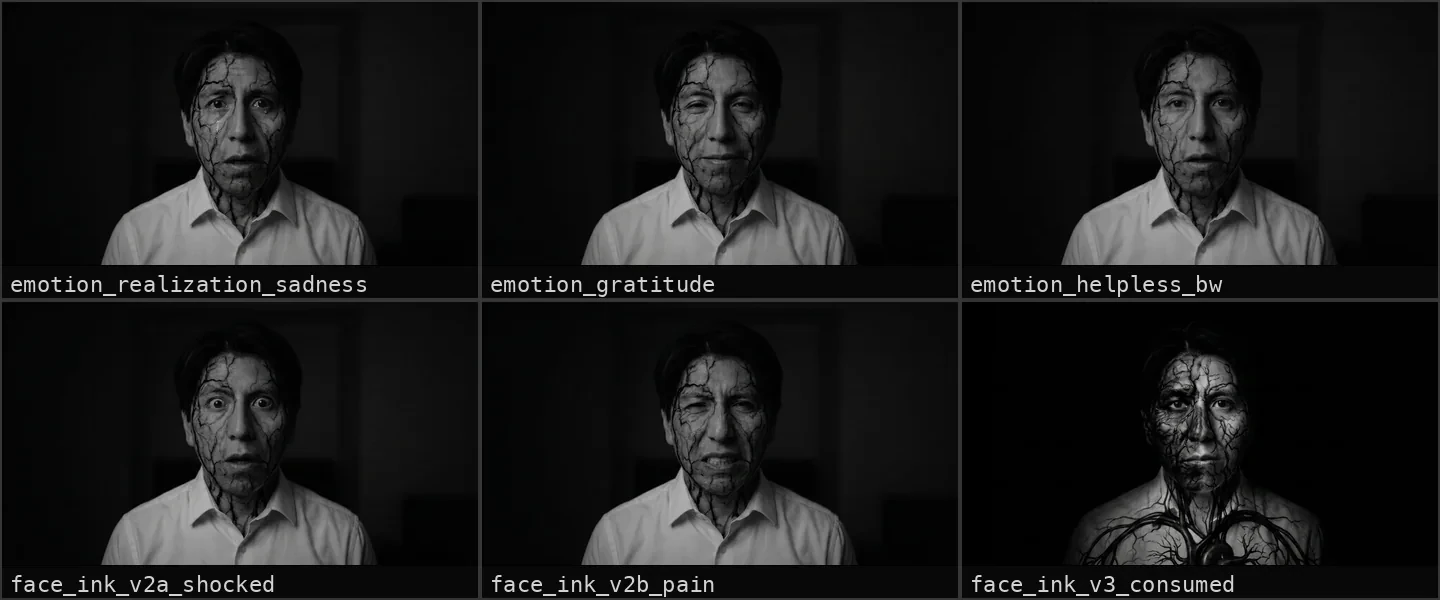
six still-image variants of black ink spreading across my face, from sadness and gratitude to near-complete coverage.
motion had to carry both changes at once: ink moving through my body while black forms begin expanding through the studio.
then the person disappears
i tested disappearance in two directions: keep the consumed body barely visible, or push the camera into black until the frame vanished.
they all worked as a disappearance, but the darkest versions stopped the motion too early. i still had music left, and the ink felt more alive when it remained visible.
after the person was consumed, i searched for what could remain. some ideas became new symbols instead of a continuation of the takeover.
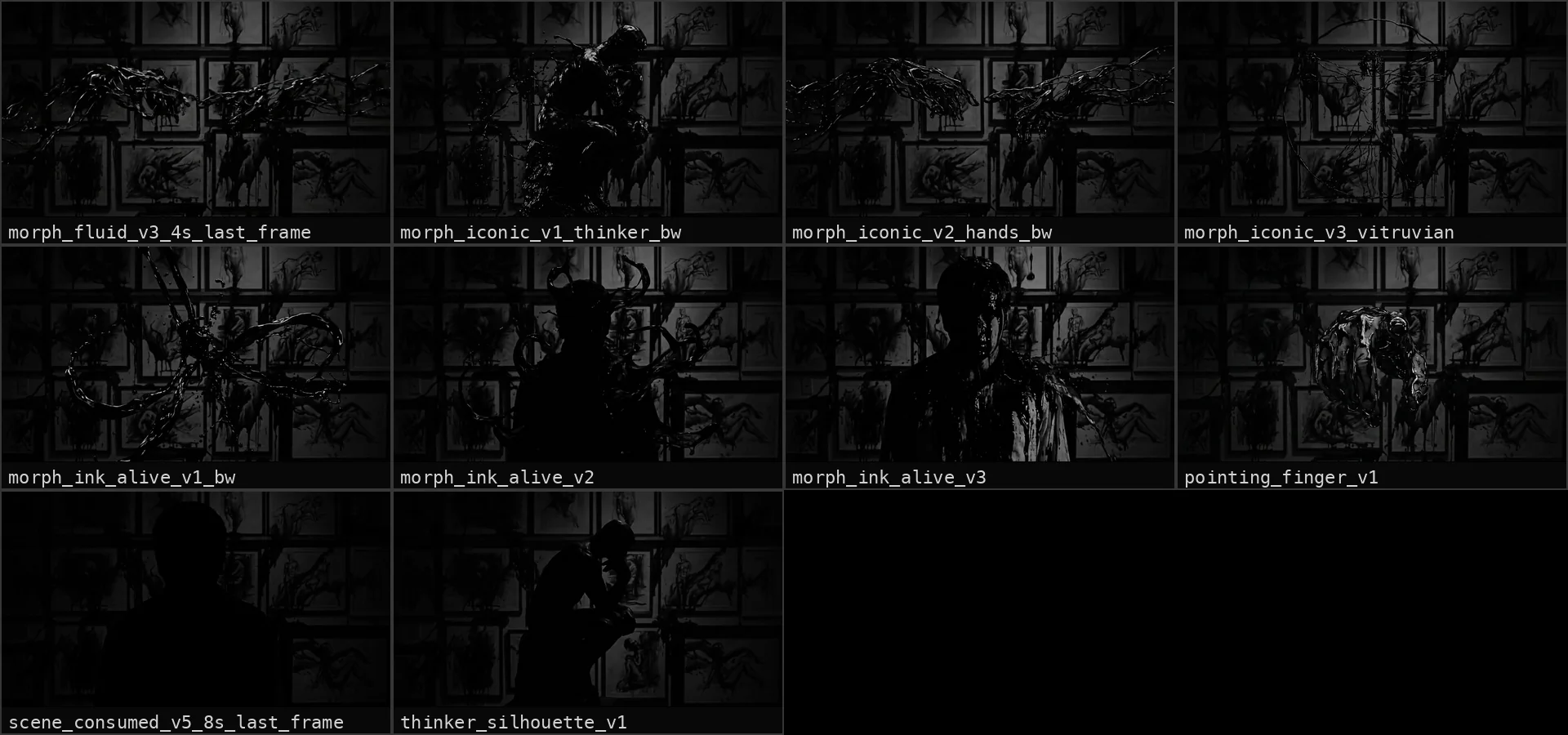
ten ending references showing a thinker, open-handed silhouette, vitruvian figure, living ink knot, pointing hand, and room-filling shadow.
only two reached motion: the seated thinker changing shape and the figure rotating into one pointing finger. i cut both. i was already spending too much time on the ending, and each added a new idea when the story only needed to keep moving.
the ink fills the room
the ink still had to carry the rest of the song, so i tested several ways to keep it moving.
the two fluid versions are the ones i still think about. damn, maybe one should have survived.
i ended with the ink consuming the room. that let the rest of the song continue without adding another symbol. after i disappear, the ink keeps moving through the studio until almost everything is black.
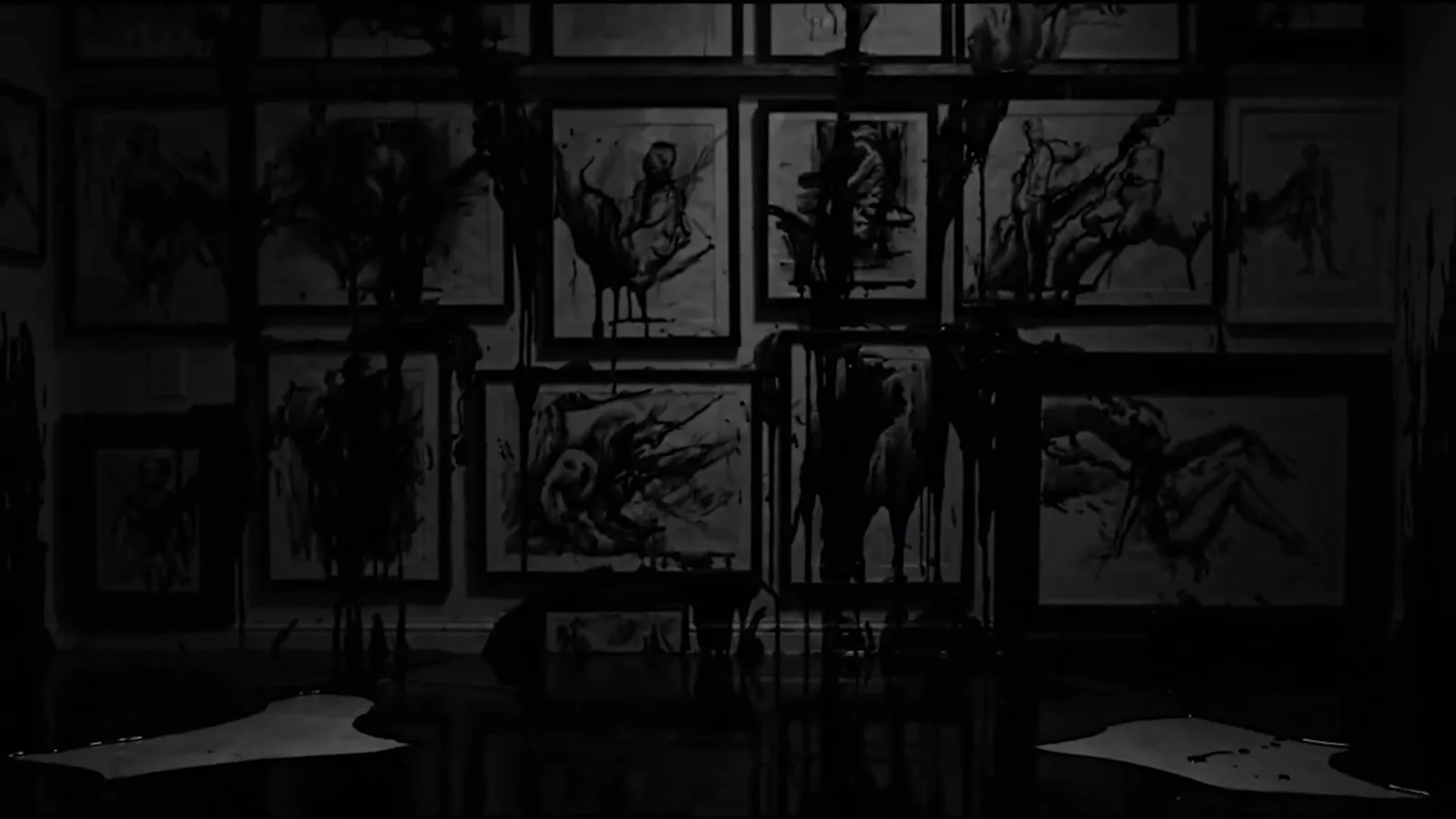
a frame from the local master showing black ink spreading across the studio and consuming the room.
it stopped making sense to separate us
the archive has 1,916 media files because ai made it easy to keep asking for another possibility. each result changed what i could imagine asking for next.
sometimes a limitation brought me back to an idea i had forgotten. sometimes a generation gave me an option i would not have reached alone. sometimes i chose a flawed result because finishing this version mattered more than continuing the search.
i made the decisions, but i did not arrive at them alone. my ideas shaped what i asked the models, their answers changed what i could see, and that changed what i wanted to make next. the process kept looping until asking which part was mine and which part belonged to the ai started feeling like the wrong question.
someone will hear this and call it collaboration. editors and collaborators also change what a creator can imagine, and nobody stops calling the work theirs. i used to think that was the right word too, until i tried to say what was actually different.
the ai did have a will. when it gave me three options, it had already picked three out of a million. that is a preference, and that preference was enough to change me. i am not going to pretend it was a neutral mirror.
but its will was not a collaborator's will. a collaborator sits across the table with their own stake: they want the work to be good for their reasons, to carry their name, to survive their career. you negotiate, and the work ends up somewhere between you. the ai had no stake. it did not want the film to succeed. it had no life to protect and no taste to defend, no reason to push back except the one i gave it. its preference existed in response to me, though shaped by everything it was trained on, and i could steer it.
that is the difference. a collaborator is a separate center of gravity you have to meet halfway. the ai was a will inside the loop of my own will. its selections changed what i could see, and what i could see changed what i asked next, and what i asked shaped its next selections. the loop never left my head.
that is why the three moments that changed the film most were still mine to decide. the failed hand tests made me see the ink drawing alone, something i had forgotten in my own fable. the two musical directions changed how i understood the ending, and i chose absorption. i stopped at v1 because finishing this version mattered more than the search. the ai's preferences widened what i could see in each one, but i was the only one in the room with a stake in the outcome.
the film shows an ink completing an artist until he disappears. making it felt almost like the opposite. ai gave me more routes, more images, and a larger space to think inside.
maybe that is why the title now feels true to me. the ai did not replace me. it completed me.
and i do not say that as comfort. this is not a tool that stays where you leave it. it is getting smarter every day, and it grows. the same thing that felt like an extension of my mind is powerful enough to overtake my brain functions. i do not know where that ends. maybe the fable was not a warning about the future. maybe it was a description of the direction we are already walking.
i do not mean that it finished the work while i stood aside. i mean that it made me able to finish what i could not finish alone, using a mind that no longer felt entirely separate from my own. that is what i mean by completed.
Anotaciones
tools used — images: gemini nano banana and gpt image 2. image to video: veo 3.1 fast. music: flow music app from google.
2026-08-11 — idea for later (not part of the essay): this essay leaves me with a bigger idea: ultra-personalized content creation. if ai can complete one person's mind, it can make a film for each person. not one film for everyone, but a version shaped around each viewer's measure, the way the ai shaped living ink around mine. the same loop that made this film would make a movie that completes each person who watches it.
and that raises the question of human will. if the story is generated to complete you, what is left of your choosing? the ink in the fable completes the artist until he disappears. a film made for each person could do the same. that is the sequel worth writing: what happens to human will when the story is built around you.
folio 28 of 46 · written in cusco, peru, 11 AUG 2026 · updated 11 AUG 2026